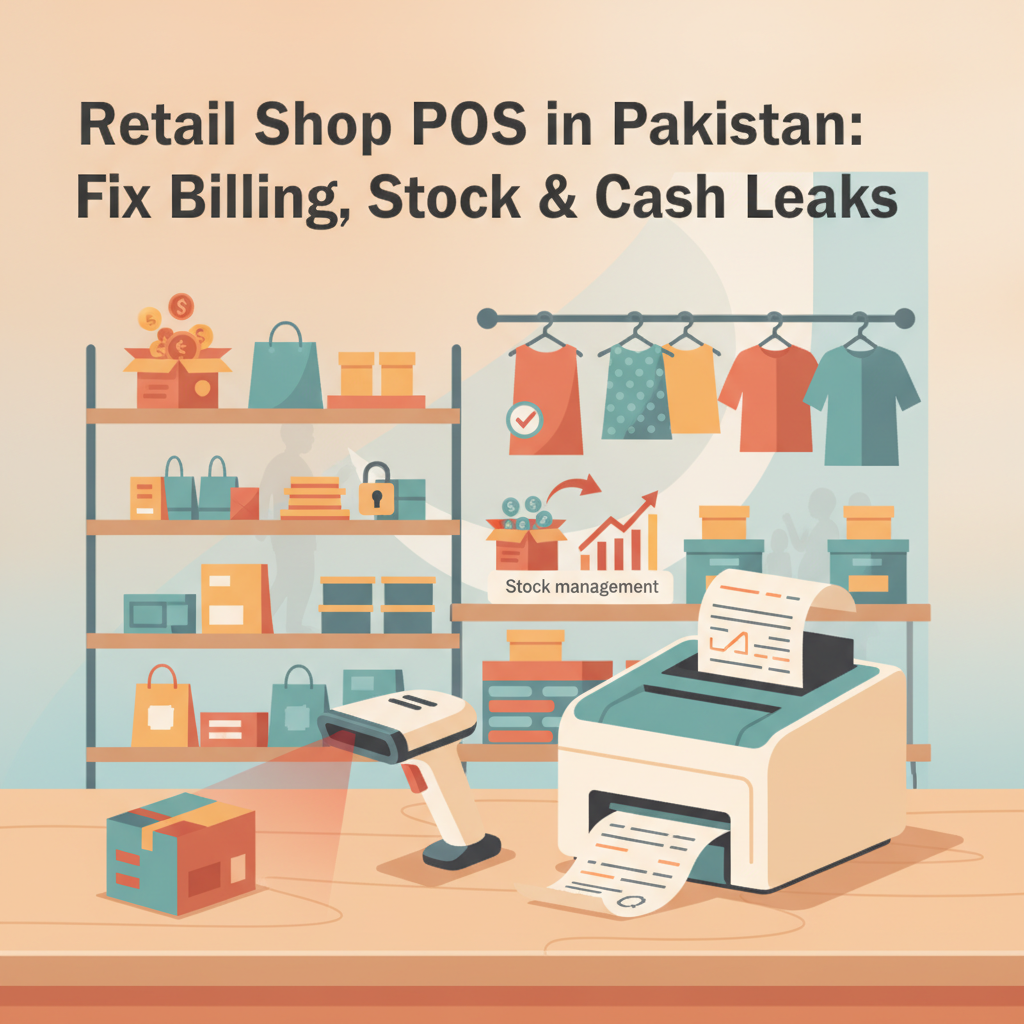
Retail Shop POS in Pakistan: Fix Billing, Stock & Cash Leaks
Learn how modern POS workflows solve evening counter delays, stock shrinkage, and cash reconciliation headaches for retail shop owners across Pakistan.
It is 8:15 PM on a Saturday in an urban Pakistani market. Your shop is packed with customers stopping by after Maghrib prayers. A shopper at the counter holds up an imported bottle of shampoo and a packet of biscuits, waiting to pay. Your counter helper hesitates, squints at an old price sticker, and shouts across the shop: "Bhai, is shampoo ka naya rate kya hai?" Behind that shopper, three other customers shift impatiently from one foot to the other. One puts down their basket, shakes their head, and walks out the door.
For independent retail shops across Pakistan—from general convenience stores and departmental outlets to cosmetics and gift shops—this scene is all too familiar. Retail represents a massive share of domestic economic activity, accounting for an estimated 18 percent of Pakistan's gross domestic product. Yet many independent retailers still manage high-volume counters with loose paper slips, mental math, and manual registers. Moving from manual guesswork to dedicated point-of-sale (POS) software is no longer an optional luxury; it is the single most effective way to eliminate billing delays, stockouts, and cash leaks.
The Three Daily Fires Every Retail Shop Owner Fights
Running a retail store involves handling hundreds of micro-transactions every single day. When you rely on informal recordkeeping or generic spreadsheets, three persistent problems drain your profits:
- Checkout bottlenecks during peak evening hours: When every price must be recalled from memory or checked manually, lines form quickly. Customers in commercial areas value speed, and slow checkouts directly forfeit sales to competing marts nearby.
- Invisible stock shrinkage and blind purchasing: Without itemised tracking, you only discover an item is sold out when a customer asks for it. Meanwhile, slow-moving stock gathers dust on the back shelves, locking up valuable working capital.
- End-of-day register mismatches: At 11:00 PM, when you count the cash drawer, the money in hand rarely matches your estimated sales. Without transaction logs linked to individual staff shifts, finding whether the shortfall came from wrong change, undercharging, or pilferage is almost impossible.
Solving the Counter Bottleneck: High-Speed Barcode Billing
The checkout counter is where customer trust is won or lost. In a traditional shop setup, cashiers face two primary billing challenges: fluctuating wholesale prices and slow transaction entry.
Eliminating Mental Math and Price Disputes
Wholesale distributors across major trading hubs like Jodia Bazaar in Karachi or Shah Alam Market in Lahore adjust trade rates frequently. When distributors increase prices, retail margins shrink unless counter prices are updated immediately. In a manual shop, staff often sell freshly received stock at the old price simply because nobody updated the mental price list.
A dedicated retail POS replaces guesswork with barcode scanning. When an item is scanned at the counter, the system immediately pulls the current retail price, applies any scheduled product discount, and prints a clear, itemised receipt on a thermal printer. The cashier does not need to remember whether a particular snack pack sells for Rs 120 or Rs 130—the database dictates the charge. This eliminates underbilling errors and ends awkward arguments with customers at the till.
Keeping the Line Moving During Power or Net Outages
In Pakistan, internet drops and power interruptions are everyday operational realities. A retail POS must never freeze simply because the broadband connection flickered. A modern retail system with offline billing allows your staff to scan barcodes, total the cart, and print receipts without an active internet connection. As soon as the connection restores, sales data syncs automatically to your central records.
Smarter Inventory Control: Eliminating Stockouts and Dead Capital
Managing inventory across 800 to 2,000 distinct retail stock keeping units (SKUs) on paper is practically impossible. Stock issues usually hit retailers in two opposite ways: unexpected stockouts of fast movers and overstocking slow movers.
Automated Low-Stock Tracking
Consider a standard consumer product: cooking oil or laundry detergent. When your shelf stock drops below four units, you risk losing not just that single sale, but the entire customer basket. A customer who cannot find their preferred brand of detergent will often leave the entire cart behind and buy everything at another mart.
With an automated inventory system, every sale recorded at the register automatically deducts unit counts in real time. Rather than conducting exhaustive midnight physical counts every evening, the system flags items that fall below your predefined minimum threshold. You get an actionable reorder list before shelves sit empty.
Managing Supplier Cost Changes
Every time you receive an invoice from a supplier, purchase costs can shift. An effective retail inventory workflow lets you update the cost price when logging new inventory batches. This keeps your calculated gross margins accurate. If a wholesale pack of tea rises from Rs 1,400 to Rs 1,520, updating the purchase record immediately reveals whether your existing retail price still delivers your target profit margin.
Retail Reporting: Tracking Real Gross Margin and Daily Cash
Many shop owners confuse gross turnover with net earnings. Taking Rs 120,000 in cash through the register on a Sunday sounds encouraging, but how much of that represents wholesale replacement cost, how much covers daily operating overhead, and how much is genuine profit?
Daily Shift and Cash Reconciliation
A structured retail POS produces an end-of-shift reconciliation summary. Before the shop closes, the software tallies total cash sales, card or mobile wallet payments, refunds, and recorded shop expenses (such as tea, utility payments, or local generator diesel contributions). The cashier must count the physical cash in the drawer against this calculated expected figure. Discrepancies are highlighted instantly, deterring casual theft and pinpointing operational mistakes before staff leave for the night.
Category and Item Profitability Reports
Sales reports show you which aisles actually fund your business. You might find that while confectionery accounts for 30 percent of total transactions, it delivers only a modest fraction of your net profit due to thin margins. Meanwhile, personal care items or stationery might generate higher gross margins per square foot of shelf space. Armed with actual sales and margin analytics, you can dedicate prime shelf space to products that generate real income.
Daily Operational Checklist for Retail Shop Owners
To keep counter operations disciplined and prevent inventory shrinkage, retail businesses should follow a standardised daily operating rhythm:
- Morning Drawer Float Count: Verify the opening cash balance in the register drawer before ringing up the first customer of the day.
- Scan-In New Shipments: Never place supplier cartons directly on display shelves. Scan incoming delivery invoices into your POS inventory first to update stock levels and track supplier purchase costs.
- Review Morning Low-Stock Notifications: Check the low-stock alert summary to compile your wholesale purchase order before distributor order-bookers arrive.
- Assign Staff Permissions: Ensure counter helpers log in under their individual staff credentials so transaction voids, refunds, and cash collections remain accountable.
- Log Mid-Day Petty Expenses: Record any cash taken out of the drawer for shop supplies, staff meals, or daily utility expenses directly in the system.
- Evening Cash-Drawer Close: Compare physical drawer cash against the POS sales total, record any variance, and review the daily profit report before closing the shop shutters.
How CPOS Streamlines Retail Shop Management
For independent retail shops looking to professionalise counter operations without heavy technical hurdles or bloated software costs, CPOS delivers practical tools built specifically for local retail workflows:
- Smart Barcode Billing: Process counter transactions in seconds with barcode scanner integration and generate clean, instant invoices on supported thermal receipt printers.
- Zero-Disruption Offline Mode: If your shop experiences internet downtime, CPOS continues billing locally without interruption, printing receipts and syncing your transaction data automatically once reconnected.
- Real-Time Stock and Low-Stock Alerts: Automatically deduct stock counts with every checkout and receive alerts when items reach reorder levels, ensuring your shelves stay consistently stocked.
- Supplier & Customer Management: Keep detailed purchase histories and track supplier accounts from a unified interface, simplifying inventory procurement.
- Actionable Sales and Profit Reports: Monitor gross sales, product margins, and store operational expenses from comprehensive reporting dashboards.
- Secure User Roles: Protect your store finances by restricting sensitive features, like editing purchase costs or approving refunds, to authorized accounts while cashiers focus strictly on checkout.
- CPOS Mobile App: Check daily store turnover, monitor staff activity, and receive real-time low-stock alerts straight from your smartphone when you are away from the counter.
- Transparent, Affordable Plans: Retailers can begin immediately on the CPOS Starter plan, which is completely free and supports up to 100 sales per day, up to 1,000 SKUs, 1 warehouse or branch, and 1 desktop plus 1 web user (with a CPOS watermark on prints). Growing shops can step up to the Basic plan at Rs 1,850 per month (supporting up to 3,000 SKUs with no watermark) or the Standard plan at Rs 3,900 per month (featuring unlimited SKUs and 3 desktop users plus 1 web user). Paid plans include a 14-day free trial, and yearly billing saves 10%.
Transform Your Shop Counter Today
Managing a retail shop in Pakistan does not have to mean wrestling with mental pricing errors, empty shelves, or evening cash reconciliations that never balance. Replacing outdated notebooks with an organized billing and inventory workflow protects your hard-earned margins, speeds up checkout during peak hours, and gives you total visibility over your daily revenue.
Ready to bring speed, accuracy, and peace of mind to your retail counter? Take the first step and start with CPOS free today.
===CONTENT===