Hardware Store POS Guide: Streamlining Stock, Khata & Billing
Running a hardware store in Pakistan involves managing thousands of small parts and contractor credit. Here is how modern POS software simplifies daily operations.
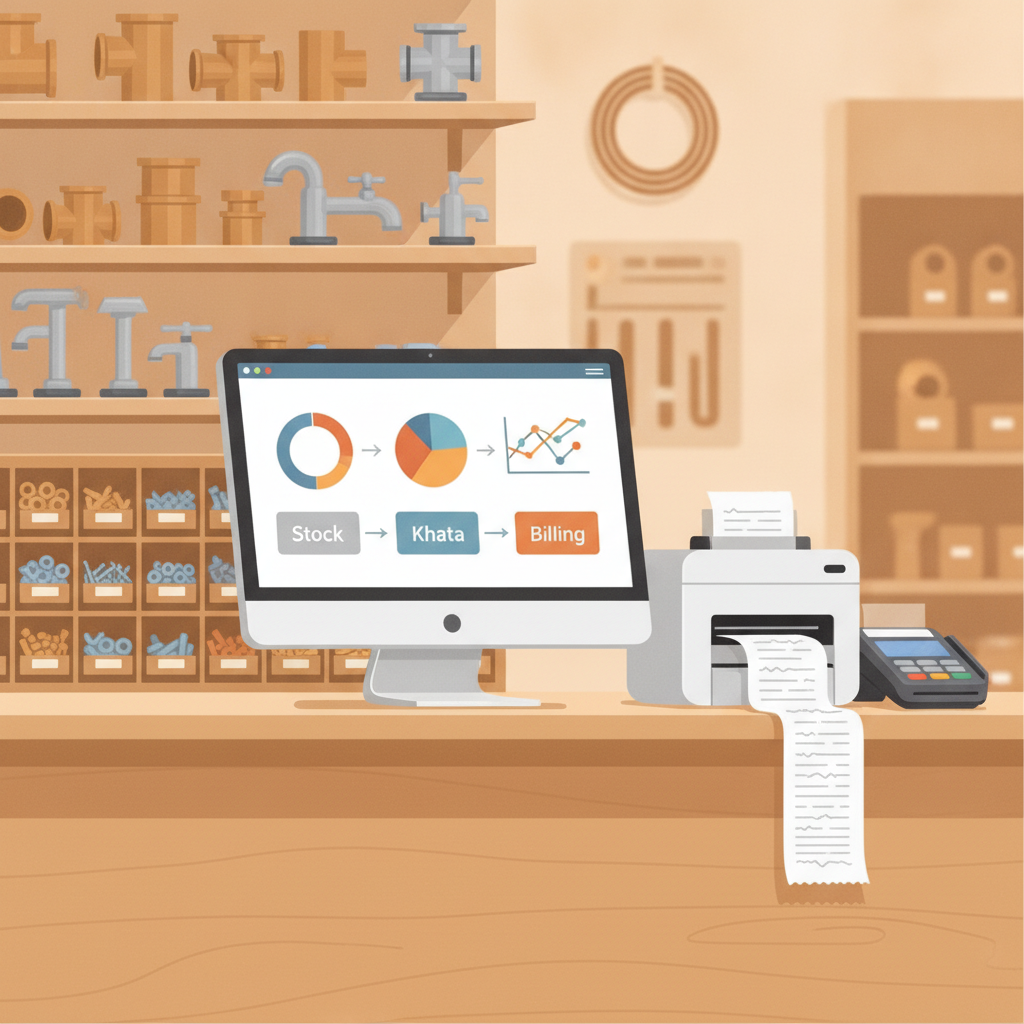
Step into any bustling hardware shop in Lahore’s Badami Bagh, Karachi’s Timber Market, or Rawalpindi’s Raja Bazaar around 9:00 AM, and the scene is almost identical. Electricians, plumbers, and independent building contractors (thekedars) crowd the counter. One needs a dozen half-inch PVC elbow joints, Teflon tape, and rawl plugs. Another asks for three coils of 2.5mm copper wire, while a walk-in homeowner wants a specific mortise door lock.
For decades, Pakistani hardware retailers have managed this daily rush through sheer memory and dog-eared paper notebooks. But as raw material costs fluctuate and customer expectations shift toward clear, itemized bills, relying on memory and paper ledgers is costing hardware store owners hard-earned profit every single day.
Running a hardware business is fundamentally different from running a boutique or a standard grocery store. With thousands of tiny components, varying units of measurement, and heavy reliance on contractor credit, a specialized point-of-sale workflow is no longer a luxury—it is an operational survival tool.
The 3 Unique Headaches of Running a Pakistani Hardware Store
Hardware retailers face distinct operational bottlenecks that general retail concepts rarely address. If you manage a sanitary, electrical, or general hardware store, these three problems will sound familiar:
1. The Massive SKU Jungle and Loose Selling
Unlike a grocery store where almost every product arrives with an EAN barcode printed on the box, hardware stores carry hundreds of unbarcoded, loose items. Screws, brass washers, copper fittings, and individual drill bits sit in plastic tubs or wooden drawers. When you stock over 2,000 distinct items across plumbing, electrical, tools, and construction materials, tracking which sizes are out of stock becomes impossible without a digital registry.
2. The Contractor "Khata" Nightmare
Contractors rarely pay cash upfront for every trip. A plumber working on a commercial plaza might visit your shop five times a day, sending different apprentices each time with handwritten slips for extra elbows, solvent cement, or pipe clamps. When these transactions are jotted down on loose sheets or crowded ledger pages, items get omitted, prices get misremembered, and month-end settlement reconciliations turn into heated disputes.
3. Price Volatility and Margin Slippage
Wholesale prices for metal goods, PVC resins, brass fittings, and copper wiring change frequently based on market dynamics and transportation costs. When you sell out of a paper notebook or rely on your counter sales staff to remember prices, you risk selling stock at last month's purchase rates, completely wiping out your net margin on high-turnover materials.
Transforming Counter Operations: Billing and Inventory in Practice
Switching from a paper-based counter to a computer- or mobile-assisted billing system directly solves these day-to-day friction points. Here is how modern billing and stock tracking function on a busy hardware counter.
Fast-Search Billing for Barcode-Free Items
While power tools and packaged paint buckets carry standard manufacturer barcodes, bulk fasteners and pipe fittings do not. A practical hardware POS allows the cashier to quickly type shorthand keywords—such as "PVC-Elbow-0.5" or "Screw-Steel-2in"—and instantly add the item to the bill with its pre-set retail rate. For packaged goods, a quick swipe with a handheld barcode scanner registers the sale in a fraction of a second, preventing checkout bottlenecks during peak morning contractor visits.
Automated Low-Stock Alerts
Running out of a high-value item like a rotary hammer drill hurts your revenue, but running out of a 30-rupee PVC coupling or a tube of silicone sealant can cost you the entire 15,000-rupee plumbing sale. Contractors prefer shops that offer complete bundles; if you cannot supply the fittings, they will take their entire pipe and valve order to the competitor down the street. Real-time inventory tracking monitors every sold item and triggers automated low-stock warnings when inventory drops below your minimum safety threshold.
Clear Thermal Receipts That Build Credibility
Handwritten carbon-copy receipts look unprofessional and invite arithmetic mistakes. Printing clean, itemized receipts on standard thermal paper gives the customer an unmistakable breakdown of sizes, quantities, and unit rates. For contractors who must present daily material bills to property owners, clear printed invoices make your shop their preferred supplier.
Managing Contractor and Supplier Accounts Digitally
Customer retention in the hardware trade depends heavily on trust and credit terms. Digital customer and supplier management protects those relationships by eliminating uncertainty:
- Dedicated Contractor Profiles: Create specific customer accounts for regular builders and tradespeople. When their assistant picks up supplies, the invoice records the exact timestamp, product description, and quantities under that account.
- Purchase History at a Glance: When a customer returns to match a tile adhesive batch, a specific paint shade, or a unique pipe diameter purchased three weeks earlier, pulling up their historical sales ledger takes only seconds.
- Supplier Purchase Auditing: Keep precise track of what you bought from wholesale distributors in regional markets, verifying received quantities against promised supplier invoices before clearing distributor payments.
Checklist: Is Your Hardware Store Ready for Digital Billing?
Review this practical checklist to assess whether your store’s current manual setup is holding back growth:
- Item Master Catalog: Have you grouped your products into logical categories (e.g., Sanitary, Electrical, Fasteners, Tools, Paints) to make inventory lookup simple?
- Minimum Stock Thresholds: Do you know your top 50 fast-moving items, and do you know the exact reorder point for each?
- Counter Hardware: Do you have a basic desktop computer, laptop, or mobile tablet paired with a standard thermal receipt printer at the main counter?
- Credit Transparency: Can you provide a contractor with a complete, printed account statement of their last 30 days of purchases in under two minutes?
- Offline Contingency: Does your billing counter remain operational during sudden broadband outages or load-shedding switches?
How CPOS Streamlines Hardware Store Management
CPOS is designed specifically for Pakistani retail realities, making it straightforward to transition your hardware shop from manual registers to organized digital management.
Here is how CPOS directly supports hardware shop owners:
- Smart Billing & Fast Searching: Ring up packaged goods with barcode scanning, or pull up loose fittings and fasteners instantly with intuitive search shortcuts. Generate professional thermal receipts that prevent counter calculation errors.
- Real-Time Inventory & Low-Stock Alerts: Keep an accurate pulse on your stock levels across every drawer and warehouse shelf. Automated low-stock alerts notify you before critical consumables run out.
- Customer & Supplier Management: Maintain detailed purchase histories for contractors and tradespeople. Review who bought what, track supplier orders, and eliminate disputed account balances.
- Resilient Offline Mode: Internet disconnections should never halt your cash desk. CPOS features a robust offline mode that lets you continue billing without internet; all transaction data is stored locally and auto-synced to the cloud once connectivity resumes, with full receipt printing on supported thermal printers.
- Mobile App Monitoring: Monitor daily sales, review real-time profit reports, and track low-stock notices directly from your smartphone while visiting wholesale markets or checking project sites.
- User Roles & Permissions: Secure login credentials and granular permissions ensure counter staff can ring up sales and handle billing without gaining unauthorized access to purchase margins or supplier costs.
Getting started is frictionless. The CPOS Starter plan is free, supporting up to 1,000 product SKUs and 100 sales per day for 1 branch with 1 desktop and 1 web user—perfect for neighborhood hardware outlets. Growing businesses with expansive catalogs can easily transition to the Basic plan at Rs 1,850 per month (up to 3,000 SKUs, watermark-free) or the Standard plan at Rs 3,900 per month (unlimited SKUs and 3 desktop users), both backed by a 14-day free trial and a guided quick setup that takes just minutes.
Take Control of Your Counter and Stock
Running a successful hardware shop in Pakistan does not require memorizing thousands of prices or spending your evenings reconciling tangled paper khatas. By bringing structured billing, automated stock alerts, and clear customer tracking to your counter, you protect your margins and build long-term trust with every builder and contractor who visits your store.
Ready to modernize your hardware store operations? Take the first step today and start with CPOS free to experience effortless billing and real-time inventory control.
===CONTENT===