10,000mAh Phone Trend: How Pakistani Retailers Can Adapt
With 10,000mAh smartphone batteries trending in Pakistan, customer demand for mobile accessories is shifting fast. Here is how retail shop owners can clear dead stock, protect margins, and capture new sales.
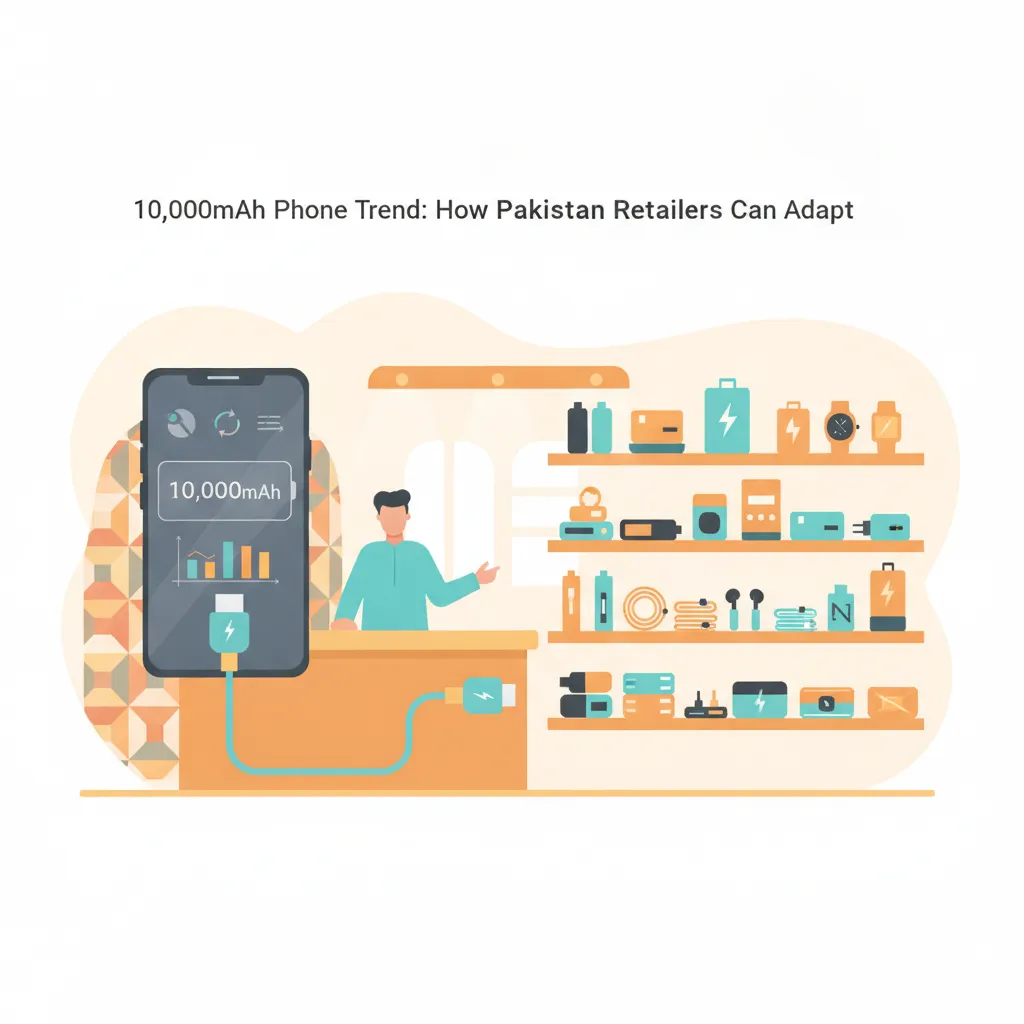
When news broke this week that mainstream smartphone makers are introducing handsets equipped with massive 10,000mAh batteries—headlined by announcements covered on GSMArena regarding the upcoming vivo Y600—Pakistani search feeds lit up immediately. For regular users, a phone that can run for two full days without seeing a wall socket feels like an answered prayer. But for anyone running an electronics shop or a mobile accessories counter in Hall Road Lahore, Saddar Karachi, or Peshawar's Saddar Bazaar, this shift is not just tech trivia. It is a direct signal that customer purchasing patterns are about to change.
In Pakistan's retail landscape, mobile phones drive foot traffic, but accessories pay the rent. Handset sales often yield slim gross margins of just 2% to 4%, while cables, fast-charging adaptors, screen protectors, and power banks routinely deliver margins between 30% and 60%. When the hardware specifications of popular smartphones take a dramatic leap, the secondary accessories market feels the shockwaves first. Shopkeepers who understand what a 10,000mAh device actually requires will capture high-margin upsells. Those who fail to adjust will find their display counters clogged with slow-moving, obsolete stock.
Why Mega-Battery Smartphones Resonate So Strongly in Pakistan
To understand how this trend impacts your counter, you must look at why Pakistani shoppers obsess over battery life. Daily life across our major cities and rural districts places severe demands on mobile power:
- Load shedding and power fluctuations: Even with solar adoption growing, unpredictable outages mean consumers prioritize devices that do not require constant top-ups during work hours.
- The gig economy and field workforce: Hundreds of thousands of delivery riders and ride-hailing drivers rely on their phones for Bykea, InDrive, Yango, and Foodpanda. A phone dying mid-shift directly cuts into daily earnings.
- Extended commutes: Commuters spending hours on public transit or motorcycles want media playback and connectivity without tethering themselves to bulky external batteries.
Until now, Pakistani consumers solved battery anxiety by carrying portable power banks. However, as silicon-carbon battery technology allows manufacturers to fit 8,000mAh to 10,000mAh into standard phone chassis without turning them into bricks, consumer behavior will pivot rapidly.
The Retail Ripple Effect: What Changes on Your Shelves
A 10,000mAh battery fundamentally alters the daily charging routine. That single hardware change triggers three specific shifts that every Pakistani shop owner needs to prepare for right now.
1. The Rapid Obsolescence of 10W to 18W Basic Chargers
For years, budget 10W and 18W charging bricks have been the bread and butter of wholesale imports. Shopkeepers buy them in cartons of 50 or 100 units from wholesale hubs because they are cheap to source and sell easily for Rs 500 to Rs 1,000. But plugging a 10,000mAh battery into an 18W charger can take between four and six hours to reach full capacity. Customers will not tolerate overnight charge times on their primary work devices.
Demand is already tilting toward 45W, 65W, and higher-wattage fast chargers capable of delivering substantial power quickly. If half of your accessory showcase is tied up in low-wattage, slow chargers, your capital is locked in inventory that will become progressively harder to liquidate at standard markup.
2. The Repositioning of Power Banks
The standard 10,000mAh power bank has been one of Pakistan’s highest-volume retail items, retailing between Rs 2,500 and Rs 4,500. But if a buyer's new phone already has a 10,000mAh battery built into it, an external battery of the exact same capacity loses its appeal. Why carry a second brick in your pocket just to get a single emergency charge?
Instead, power bank demand is bifurcating into two distinct categories: compact, lightweight emergency mini-chargers for quick boosts, and heavy-duty 20,000mAh to 30,000mAh blocks capable of fast-charging multiple devices. Retailers must be careful not to over-order mid-tier 10,000mAh power banks that offer slow standard USB-A output.
3. Cable Quality and Warranty Disputes
Fast charging large battery packs requires certified high-amperage cables (5A and 6A Type-C cords with integrated e-marker chips). Cheap, unbranded copper-clad aluminum cables overheat when pushed beyond 15W, leading to melted connector heads, burned charging ports, and angry customers returning to your shop demanding refunds.
When customers experience slow charging or damaged ports, they rarely blame their cheap wire; they blame the shopkeeper who sold it to them. Stocking certified fast-charging cables with proper retail packaging and clear wattage labeling protects your reputation and drastically cuts down on return friction.
Checklist: 5 Practical Steps to Protect Your Accessory Margins
Rather than waiting for slow stock to gather dust, smart retailers take proactive inventory measures when new hardware trends emerge. Here is a practical five-step plan for your shop:
- Audit your slow-charger inventory today: Count exactly how many sub-20W charging bricks and standard micro-USB or basic Type-C cables you hold in stock. If your holding quantity exceeds 30 days of sales, package them into discount clearance bundles or offer them as value-add throw-ins with low-end feature phones.
- Expand your high-wattage GaN and fast-charge lineup: Allocate working capital toward reputable 45W, 65W, and 90W fast chargers. Ensure your staff knows how to explain charging protocols to customers who ask why a quality fast charger costs more.
- Stock certified 100W-rated Type-C cables: Place premium, braided 5A/100W cables near your billing till. Train your sales assistants to offer a matching high-speed cable whenever a customer buys a fast charger or a modern handset.
- Re-evaluate power bank stock ratios: Shift your wholesale purchasing away from standard 10,000mAh units toward 20,000mAh+ models featuring Power Delivery (PD) fast-charging ports, while keeping a small selection of ultra-compact pocket chargers.
- Track stock movement by specific wattage: Avoid logging all charging adaptors under a single generic "Mobile Charger" line item in your records. Differentiate your SKUs by output wattage and brand so you can see which models turn over within days and which ones linger for months.
How CPOS Helps Mobile and Tech Retailers Stay Ahead
Navigating changing consumer trends requires complete visibility over what is actually selling across your counter every single day. CPOS point-of-sale software is built specifically for Pakistani retail environments, giving mobile and electronics shops the precise tools needed to manage inventory and safeguard profitability.
With CPOS, you can track real-time inventory and set automatic low-stock alerts, ensuring you never run out of fast-moving 65W chargers while catching slow-moving accessories before they turn into dead capital. For mobile shops managing varied product lines, CPOS supports comprehensive tracking for mobile devices, IMEIs, warranty records, and accessories right down to the individual SKU.
Billing is swift and seamless. Smart billing with barcode scanning and instant thermal invoice printing keeps queues moving during peak evening rushes. Because power cuts and unreliable internet connections are daily realities in Pakistani commercial markets, CPOS features a dependable offline mode. You can continue scanning barcodes, generating sales, and printing receipts even when the internet drops. The moment your connection restores, CPOS automatically syncs your sales data to the cloud with secure, encrypted storage.
Whether you manage a single counter on the free Starter plan—which supports up to 100 sales per day and 1,000 product SKUs—or operate a busy multi-counter store on the Basic plan (Rs 1,850 per month) or Standard plan (Rs 3,900 per month), CPOS delivers sales, profit, and expense analytics so you always know your exact gross margins at closing time.
Conclusion
Technological leaps like 10,000mAh smartphone batteries reflect an evolving Pakistani consumer who demands durability, speed, and real utility. For shop owners, these trends should not cause anxiety; they represent a fresh opportunity to refresh shelves, eliminate dead stock, and capture higher accessory margins.
By monitoring what sells, adjusting your wholesale orders before consumer interest shifts, and keeping strict digital records of your stock and supplier costs, your business can stay consistently profitable regardless of how fast market trends move.
Ready to upgrade your shop's billing, inventory tracking, and sales analytics? Take control of your retail operations today and start with CPOS free.