Fixing Cash Mismatch: A Daily Till Guide for Pakistani Shops
Daily cash drawer shortages silently destroy retail profit margins. Learn why discrepancies occur and follow a step-by-step till balancing routine to protect your cash flow.
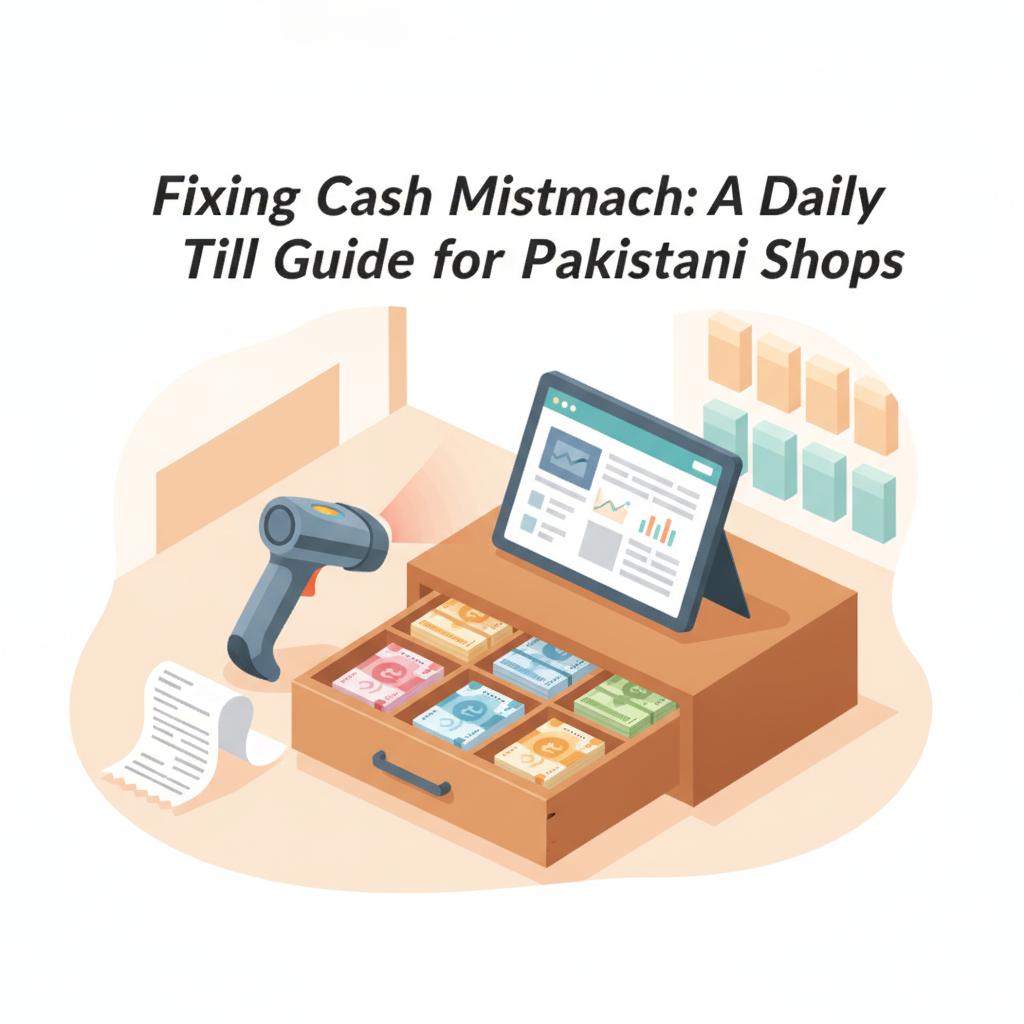
Every retail shopkeeper in Pakistan knows the sinking feeling that accompanies closing time. It is 10:30 PM. The shutters are pulled halfway down, the street traffic has quieted, and you are sitting on your counter stool counting the currency notes from the cash drawer: bundles of Rs 5,000s, Rs 1,000s, Rs 500s, and crumpled stacks of Rs 100s and Rs 50s. You pull out your daily register or rough notebook, tally your estimated sales, and notice a glaring shortfall: your physical cash is short by Rs 2,800.
Where did that money go? Did a cashier make an error during the post-Isha rush? Did you or a partner pull cash from the till to pay a local supplier or buy evening chai without writing it down? Did someone issue a cash refund for a returned item without an entry? Or did money walk out the door unnoticed? When cash mismatch becomes a daily routine, it does not just cause stress—it silently consumes your take-home income.
The Hidden Cost of Cash Register Discrepancies
Operating a retail business in Pakistan—whether a grocery store in Lahore, a medical store in Rawalpindi, a garment outlet in Faisalabad, or a mobile accessories shop in Karachi—means dealing with narrow margins. In many traditional retail categories, net profit margins hover between 10% and 18%. That means out of every Rs 100,000 in sales, your actual take-home profit after rent, utilities, staff salaries, and product procurement may be only Rs 12,000 to Rs 15,000.
If your register is short by just Rs 1,500 every evening, that adds up to Rs 45,000 disappearing every month. You are not simply losing a tiny fraction of total turnover; you are surrendering a major portion of your net personal earnings. Over an entire year, half a million rupees can vanish into unaccounted discrepancies.
Recent data from the State Bank of Pakistan (SBP) shows that while digital channels and instant payment systems like Raast are expanding rapidly across formal commerce, cash remains a dominant daily touchpoint on physical retail counters. Managing that constant flow of physical paper money requires airtight procedures, or your register will inevitably bleed cash.
Why Pakistani Shops Face Daily Till Mismatches
Cash discrepancies rarely stem from a single large incident. More often, they are the byproduct of half a dozen small, unchecked habits that compound throughout a busy 12-hour workday.
1. Unrecorded Drawer Withdrawals
The cash drawer often serves as an informal pocketbook. An owner pulls Rs 1,000 to pay the van driver delivering cold drinks. An assistant takes Rs 300 to pay the tea stall. A brother takes Rs 2,000 for household expenses. When these out-of-drawer payments occur without an immediate, formal written voucher, they disappear from memory by nightfall. At closing, the register reports missing cash that was actually spent on legitimate expenses.
2. Rush-Hour Change Errors
Between 6:00 PM and 9:30 PM, retail footfall in Pakistani commercial markets surges. Cashiers face crowded counters with multiple customers waiting. Handing back change under pressure frequently causes mistakes: mistaking a Rs 500 note for a Rs 1,000 note, miscounting change, or accepting cash while distracted by another customer's question. A few bad calculations over several hours quickly create a Rs 1,000 or Rs 2,000 shortfall.
3. Informal Customer Credit (Khata) and Hybrid Payments
In many neighborhoods, loyal customers buy on credit or make split payments. For example, a customer buys Rs 4,500 worth of groceries, pays Rs 2,500 in cash, and asks to put the remaining Rs 2,000 on their khata. If the counter staff fails to log the split transaction correctly and notes it down simply as a cash sale, the drawer will be short by Rs 2,000 at closing. Conversely, if an old customer pays off Rs 3,000 of past debt and the payment is mixed with the day's fresh sales cash, the drawer will end up inexplicably over.
4. Informal Product Swaps and Returns
When a customer returns a shirt or an unneeded medicine strip, counter staff often refund cash straight out of the drawer or allow an exchange with price differences settled in cash. Without an updated sales record, the cash drawer decreases, but the sales total on paper remains unchanged.
5. Shared Registers Without Accountability
In many shops, two or three counter attendants work the same drawer across different shifts. When the till is counted at 11:00 PM and Rs 3,500 is missing, who made the error? Did the morning attendant give incorrect change, or did the evening attendant misplace an invoice? Without individual accountability, no one takes ownership, and the leak persists.
A 6-Step Daily Till Balancing Checklist
Eliminating cash leaks does not require complex accounting degrees. It requires a disciplined, repeatable routine that your counter staff executes every single day.
- Lock in a Fixed Morning Float: Never start the day with an arbitrary pile of money. Keep a dedicated "opening float" (for example, exactly Rs 10,000 in mixed smaller denominations: Rs 10, Rs 50, Rs 100, and Rs 500 notes). The opening float is counted and verified before the first customer walks in.
- Enforce the "Paper for Cash" Petty Cash Rule: Never take a single rupee out of the drawer for supplies, chai, generator fuel, or vendor payments without leaving an expense slip inside the drawer. The slip must state the date, time, exact amount, purpose, and signature of the person who took the cash. When counting the till, expense slips count as physical cash.
- Handle Khata Repayments Separately: When a customer pays down their outstanding credit balance, do not mix that payment with the daily sales cash without logging it under customer accounts. Better yet, keep a distinct pocket or envelope for credit recoveries so daily retail sales stay clean.
- Conduct Blind Shift-End Counts: When an employee finishes their shift, have them perform a "blind count." The cashier counts the physical cash by denomination (number of 5,000s, 1,000s, 500s, etc.) and writes down the total before checking what the computer or register thinks should be there. This prevents cashiers from guessing or attempting to adjust numbers to match expectations.
- Separate Digital and Card Payments: If customers pay using digital banking apps, QR codes, or bank cards, keep those totals recorded in distinct columns. A common mistake is seeing a total sales figure of Rs 50,000, finding only Rs 40,000 in the drawer, and panicking—only to realize later that Rs 10,000 arrived through mobile transfers.
- Set an Acceptable Variance Threshold: In high-volume retail with thousands of small cash exchanges, an exact zero variance every single day is unrealistic. Establish a clear tolerance band (for instance, Rs 50 to Rs 100 per day). Anything within that threshold is logged as minor cashier shortage/overage. Anything above it triggers an immediate review of the day's large transactions and receipts.
How CPOS Helps Keep Your Cash Register Honest
While paper logs and discipline help, running a busy retail shop solely on manual calculations leaves room for human fatigue. This is where modern point-of-sale software creates absolute transparency.
CPOS is point-of-sale software tailored for businesses across Pakistan, offering a full suite of operational tools including a Starter plan that is completely free for small businesses (supporting up to 100 sales per day and 1,000 product SKUs). Here is how dedicated POS features resolve daily register leaks:
- Smart Billing with Barcode Scanning: Every sale is scanned and calculated automatically. Staff never need to calculate totals or item prices manually, removing basic math mistakes from the checkout counter.
- Comprehensive Reports and Analytics: At the close of each day, CPOS generates automated sales, profit, and expense reports. You can compare your physical till cash directly against recorded cash sales, recorded expenses, and customer khata entries in seconds.
- User Roles and Permissions: CPOS includes secure logins with role-based permissions. Cashiers can ring up sales and print receipts, but they cannot delete past invoices, modify inventory counts, or offer unauthorized discounts without manager authorization. This keeps your records tamper-proof.
- Customer and Supplier Khata Management: When a customer makes a partial payment or pays on credit, CPOS logs the transaction to their individual profile with complete purchase history. You always know exactly how much cash entered the till and how much remained on credit.
- Mobile App with Real-Time Alerts: Even when you are away from the counter, the CPOS mobile app lets you monitor sales totals and track team activity on your phone. If midday sales look unusually low or sudden expenses are entered, you spot it immediately.
- Reliable Offline Mode: Electricity load shedding or unstable internet connections will not stop your register. CPOS offline mode stores billing data locally and automatically syncs with secure cloud storage as soon as the connection returns, ensuring zero unrecorded sales.
For growing businesses needing higher capacity, CPOS offers paid tiers such as the Basic plan at Rs 1,850 per month (up to 3,000 SKUs) and the Standard plan at Rs 3,900 per month (unlimited SKUs and multiple desktop users), with a 14-day free trial on all paid plans and a 10% discount on yearly billing.
Regain Control Over Your Daily Profits
Every rupee lost at the cash counter is pure net profit that should have stayed in your business or supported your family. When your till matches your actual sales every single night, the evening anxiety disappears. You know what your shop earned, you know your expenses were legitimate, and your staff operates with clear, healthy accountability.
Do not let unrecorded change, casual petty cash withdrawals, and paper clutter dictate the health of your retail store. Take control of your counter operations, streamline your billing, and start with CPOS free today.